Monday, April 9, 2012

Wednesday, April 4, 2012
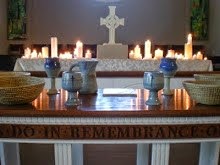
It is for this reason that I have come to this hour
 Mark 14
22 While they were eating, he took a loaf of bread, and after blessing it he broke it, gave it to them, and said, "Take; this is my body." 23 Then he took a cup, and after giving thanks he gave it to them, and all of them drank from it. 24 He said to them, "This is my blood of the covenant, which is poured out for many. 25 Truly I tell you, I will never again drink of the fruit of the vine until that day when I drink it new in the kingdom of God."
 John 13
1 Now before the festival of the Passover, Jesus knew that his hour had come to depart from this world and go to the Father. Having loved his own who were in the world, he loved them to the end. 2 The devil had already put it into the heart of Judas son of Simon Iscariot to betray him. And during supper 3 Jesus, knowing that the Father had given all things into his hands, and that he had come from God and was going to God, 4 got up from the table, took off his outer robe, and tied a towel around himself. 5 Then he poured water into a basin and began to wash the disciples' feet and to wipe them with the towel that was tied around him. 6 He came to Simon Peter, who said to him, "Lord, are you going to wash my feet?" 7 Jesus answered, "You do not know now what I am doing, but later you will understand." 8 Peter said to him, "You will never wash my feet." Jesus answered, "Unless I wash you, you have no share with me." 9 Simon Peter said to him, "Lord, not my feet only but also my hands and my head!" 10 Jesus said to him, "One who has bathed does not need to wash, except for the feet, but is entirely clean. And you are clean, though not all of you." 11 For he knew who was to betray him; for this reason he said, "Not all of you are clean." 12 After he had washed their feet, had put on his robe, and had returned to the table, he said to them, "Do you know what I have done to you? 13 You call me Teacher and Lord—and you are right, for that is what I am. 14 So if I, your Lord and Teacher, have washed your feet, you also ought to wash one another's feet. 15 For I have set you an example, that you also should do as I have done to you. 16 Very truly, I tell you, servants are not greater than their master, nor are messengers greater than the one who sent them.
Wednesday, February 1, 2012
Creating in the Image of God
L'Art has adopted the two spaces in the narthex flanking the sanctuary doors. These spaces are called the "niches" and provide an ideal location for three-dimensional installations. The intention is to rotate the exhibits every three or four months. These initial installations explore the theme of Creation.

For the installation on the left (west) side, Molly Elkind created a two-part sculpture entitled Where the Earth Meets the Sky. Molly made this piece out of handmade paper, stitching, and hand-dyed silk. A dyed fabric backdrop evokes the starry spaces in which our earth and its atmosphere find their home.

Close-up view of the sculptured pieces
The Artist's Statement for this exhibit:

Artist's Statement:
This work is meant to be a visual expression of appreciation for the symmetry between the first chapter of Genesis and the first chapter of John. In Genesis, God literally speaks creation into existence (And God said “Let there be light”). In the prologue to John, the evangelist affirms that the same creative force that formed the universe has become flesh and lived among us, and this force is referred to as the Word (or logos, in the original Greek.)
Scholars say that the Greek word logos has a wide range of meaning, but is usually translated as the “word of God”. The Greek letters for logos are used in the altered book that is the focal point of this artwork. By including Scripture passages and a book and a tree, it is hoped that viewers will be inspired to contemplate the relationships between words, books, trees, the Creation Story, and the Word.

Close-up view of the altered book


For the installation on the left (west) side, Molly Elkind created a two-part sculpture entitled Where the Earth Meets the Sky. Molly made this piece out of handmade paper, stitching, and hand-dyed silk. A dyed fabric backdrop evokes the starry spaces in which our earth and its atmosphere find their home.

Close-up view of the sculptured pieces
The Artist's Statement for this exhibit:
“And God said, ‘Let the waters under the sky be gathered together into one place, and let the dry land appear.’ And it was so. God called the dry land Earth.” Genesis 1:9-10
When I made this piece almost ten years ago, the Creation story of Genesis was on my mind, and I was working a lot with handmade paper. Often I would press damp sheets of paper to the trunks of trees to dry, thereby embossing them with the tree’s bark texture. For this piece, I then formed, painted, and stitched the sculptures from this textured paper. Stitching on the green “earth” form resembles the lines on maps, while on the “sky” form it resembles the planets and their orbits. Each piece is lined with contrasting silk whose color links it to its counterpart. While there is space between the “earth” and the “sky” I like to think the two pieces are in dialogue with each other.
In the niche on the right, Nancy Langham created a mixed-media sculpture entitled And It Was So, utilizing tree branches, an altered book, and stitched "leaves".
Artist's Statement:
This work is meant to be a visual expression of appreciation for the symmetry between the first chapter of Genesis and the first chapter of John. In Genesis, God literally speaks creation into existence (And God said “Let there be light”). In the prologue to John, the evangelist affirms that the same creative force that formed the universe has become flesh and lived among us, and this force is referred to as the Word (or logos, in the original Greek.)
Scholars say that the Greek word logos has a wide range of meaning, but is usually translated as the “word of God”. The Greek letters for logos are used in the altered book that is the focal point of this artwork. By including Scripture passages and a book and a tree, it is hoped that viewers will be inspired to contemplate the relationships between words, books, trees, the Creation Story, and the Word.

Close-up view of the altered book

Close-up view of the stitched leaves
Monday, January 16, 2012
Art is a Spiritual Practice

Molly instructing at the Presbyterian Women's Retreat
Making art is an ancient spiritual practice (see Exodus 35), and Molly Elkind practices a lot! Molly is the team leader of L'Art (the Liturgical Art Team) and a professional artist and art instructor. The spotlight is on Molly in this post because she has been honored by being interviewed for Art is Worship Radio. The host, Vanessa Lowry, interviews artists of different faiths on the common theme of how they use inspiration and creativity as an expression of their spirituality. Molly was interviewed in January and the podcast can heard on Empower Radio

Opening Night at Molly's Solo Show at Mercer University
Molly holds an MA in Studio Art, with a concentration in Fibers, and her work has been exhibited in juried shows locally and nationally, as well as being included in private collections.
Molly loves this work that allows her "to say yes instead of no. Yes to the possibilities. Yes to creativity. Yes to making mistakes and picking up and going on. Yes to that uncertain process of creating. Making art allowed me to do that. What I realized in the process of making art was that this was bigger than me. There was something else going on here besides my own brain and my own abilities. There is a creative force that is moving through me and that allowed me to come back to a life of faith."
Molly works  large!
 large!
L'Art is blessed to have such a talented leader.
Friday, July 22, 2011
Grace Upon Grace

In conjunction with the summer sermon series that engaged the theme of Grace, L'Art invited the APC congregation to submit their original photos for a photo exhibit entitled "Snapshots of Grace".
The series and the exhibit lasted 4 weeks. This was the second annual photo show for APC, and again the submissions were beautiful, varied, surprising, and apt visual expressions of a theological concept. Such talent!
Thursday, July 21, 2011
Easter is a season, not just a day

The banners being used in worship today were designed for church seasons and celebrations such as Easter, Baptism, Communion, or Christmas. The liturgical color of white is used when we mark special events in Christ’s life that intersect with ours and fill us with hope. The predominant color of the banners is white, which symbolizes purity and holiness. Silver and gold accents enhance the white with allusions to costly treasure. Blue highlights, the color of water and sky, are symbolic of both heaven and baptism. The composition of the design is meant to give the viewer an uplifting, hopeful feeling.

Right Banner

Left Banner

Pulpit Cloth
Jesus and the Empty Tomb


Our sanctuary, and close-up views of Left and Right Banners
In worship today, we proclaim the Resurrection of Jesus. Today's banners were designed to help us think about the joy, as well as the mystery, associated with this event.
The banner on the left is an imagination of how it may have looked as the resurrected Jesus stepped out of the tomb. Scripture is silent, of course, about how this looked; there were no witnesses to the act of resurrection, only later, to the actual resurrected Jesus.
Shades of gold are used for the image of Jesus, to represent his glorified state. The brushstrokes are ethereal, yet the figure is recognizably human, symbolizing the mysterious state that Jesus is now in. This is a glorified Christ, who came to dwell among us, to die for us, and to claim everlasting life for us, so that we may rejoice and know just how much God loves us.


Subscribe to:
Posts (Atom)