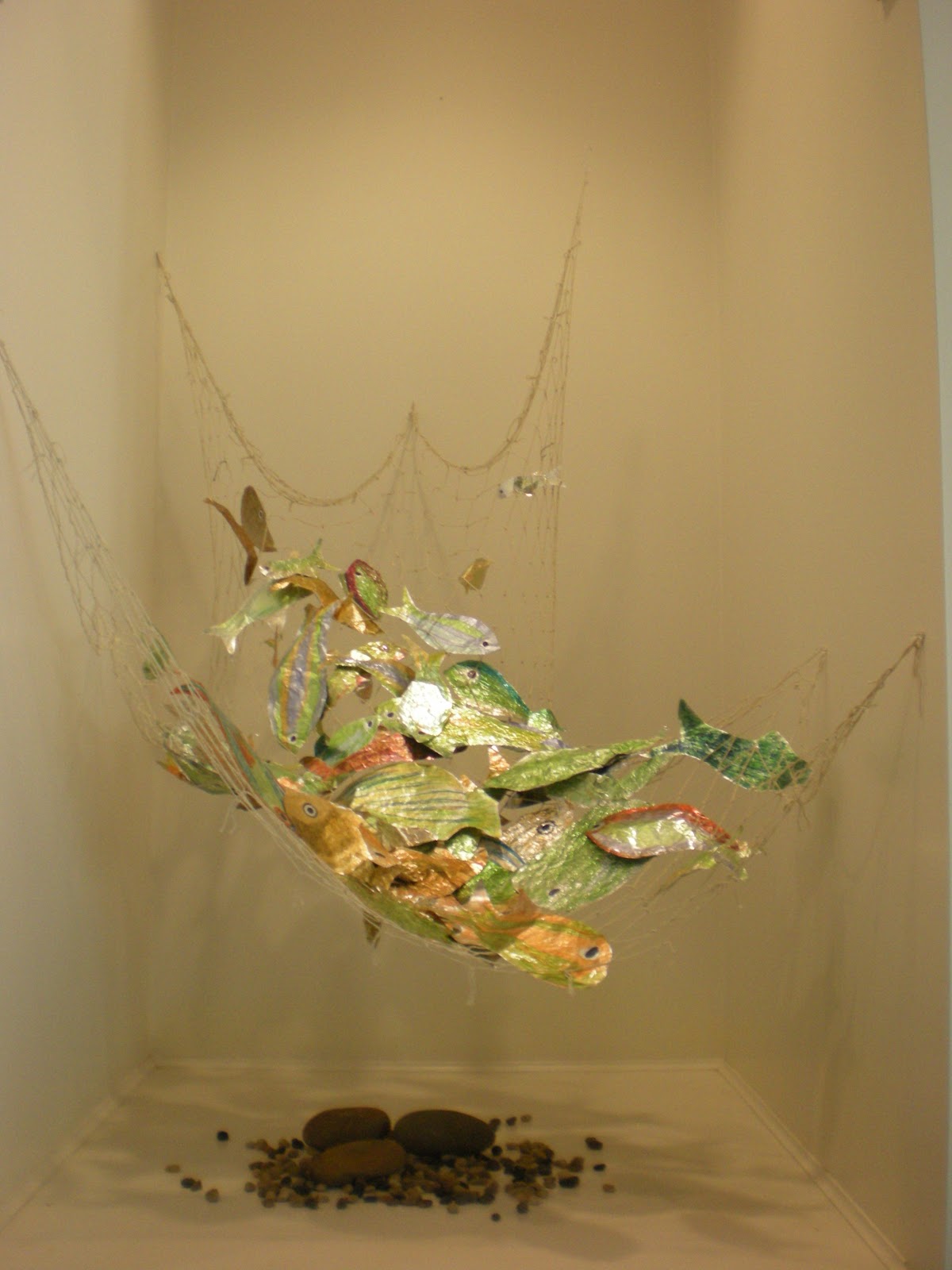
"Cast the net to the right
side of the boat, and you will find some."
So they
cast it, and now they were not able to haul it in because there were so many
fish.
This installation illustrates
the “marvelous draught of fish” – a story that happens twice in the ministry of
Jesus.
On the earlier occasion, we read in Luke
5:1 – 11 that Jesus gets into the boat of some fishermen and teaches the crowd
from the boat. He then instructs the fishermen to let down their nets for a catch.
Simon Peter answers that they have been fishing all night without catching any
fish. “Yet if you say so, I will let down the nets.” They then catch so many
fish that their nets begin to break. Jesus tells James, John, and Simon Peter that
they will now be catching people, not fish. When they bring their boats to
shore, they leave everything to follow Jesus.
The second telling of this miracle, in
John 21:1 – 8, seems to recall the first catch. In this telling, Jesus has been
resurrected. He stands on the beach before his disciples, but they do not
recognize him. Again, they have been fishing unsuccessfully and Jesus instructs
them to cast from the other side of the boat. They obey and catch so many fish
that they can not haul the net back in. And now they recognize their Lord.
Perhaps this is Jesus’ way of reaffirming their
original call. After his death, the disciples have been lost and aimless
without the guidance of their Lord. Could
this second occurrence of a miraculous catch be intended to remind and
redirect them back to the business of catching people?
"Let anyone among you who is without sin be the first to throw a stone"
This installation
suggests the setting of the scene from John 8:1 – 11.
This scripture passage
says that Jesus is teaching the people when the scribes and Pharisees bring
forth a woman they say was caught in the act of adultery. They cite the law of
Moses commanding that she be stoned. They test Jesus by asking “what do you say?” Jesus bends down and writes
with his finger on the ground. He stands up and pronounces “Let anyone among
you who is without sin be the first to throw a stone at her." He then
bends back down and continues to write on the ground. When the message finally
resonates with the crowd, they go away, one by one. Jesus straightens back up
and addresses the woman. “Has no one condemned you? … Neither do I condemn you.
Go your way and from now on do not sin again.”
Many lessons can
be taken from this narrative. Note how Jesus separates himself from the mob by
bending down, joining with the woman in her vulnerability. He brings a calming
influence by pausing before responding to their question. However, by refusing
to command that she be stoned, Jesus is not implying that no one has the moral
authority to condemn. There is no false optimism that we can do as we please
because God will always forgive us. Jesus condemns the sin when he tells the
woman “do not sin again”. The message of the gospel is deeper than just
avoiding a life of sin, however. Through the grace of Christ, we have a new
quality of life that overcomes the power of sin. Jesus calls us to new life.
Once again, APC members share their artistic talents and
faithful visions. Please take a moment to pause at the niches in the narthex to
view Sam Elkind's photography and Mary Busman's water color painting.
The
Rooster
by Mary Busman
The Silver Dorking rooster
represented in the painting is an ancient breed believed to have existed during
the time of Julius Caesar. Sources reveal that the Romans introduced them as
they colonized territories conquered by their legions. The proud, haughty appearance
of the rooster may have reminded the subject people of the Roman soldiers.
Early Christians upon viewing the birds
might have shared this viewpoint, but also would have been reminded of Simon
Peter’s denial of his Lord. Before the cock crows, you will have denied
me three times (NRSV John 13:38).
Present day Christians are not so
different from the early believers. We too, associate a rooster and its
crowing, with denial. Aware of our human frailty, we share much with Peter. It
is with gratitude that we continue reading in John and hear Jesus say to the
Disciples, Do not let your heart be
troubled, Believe in God, believe also in me (NRSV John 14:1).
Each morning, about an hour before
sunrise, the Silver Dorking rooster heralds the arrival of dawn. Boldly it
announces a new day, serving as a call to confession for Christians and the
promise of redemption.
Sheep in Light
and Shadow
by
Sam Elkind
This image recalls
the passage from The Gospel of John, Chapter 21, when the resurrected Jesus reveals
himself at breakfast to the disciples on the beach of the Sea of Tiberius.
When they had finished eating,
Jesus said to Simon Peter, “Simon son of John, do you
love me more than these?”
“Yes, Lord,” he said, “you know that I
love you.”
Jesus said, “Feed
my lambs.”
Again Jesus said, “Simon son of John, do you love me?”
He answered, “Yes, Lord, you know that
I love you.”
Jesus said, “Take
care of my sheep.”
The third time he said to him, “Simon son of John, do you love me?”
Peter was hurt because Jesus asked him
the third time, “Do you love me?” He said, “Lord, you know all things; you know that I love you.”
Jesus said, “Feed
my sheep.
As
sheep of the Lord, we seek to live in the light, not the shadows.
────────────────────────────
Readers of
the Gospel of John have wondered why Jesus repeated his question to Peter "do
you love me" three times. Commentators have observed that Peter's betrayal
happened three times. Perhaps Jesus is offering forgiveness in equal measure,
as he reclaims Peter's discipleship.
According to the Day of Pentecost story in Acts 2:1-13, God gave the
gift of the Holy Spirit to empower witnesses to the resurrection. On the Day of Pentecost we celebrate the gift of the Holy Spirit
descending in a mighty rush of wind and flame to inspire the church’s
proclamation of Christ’s rising and to empower its mission and ministry
to the world.
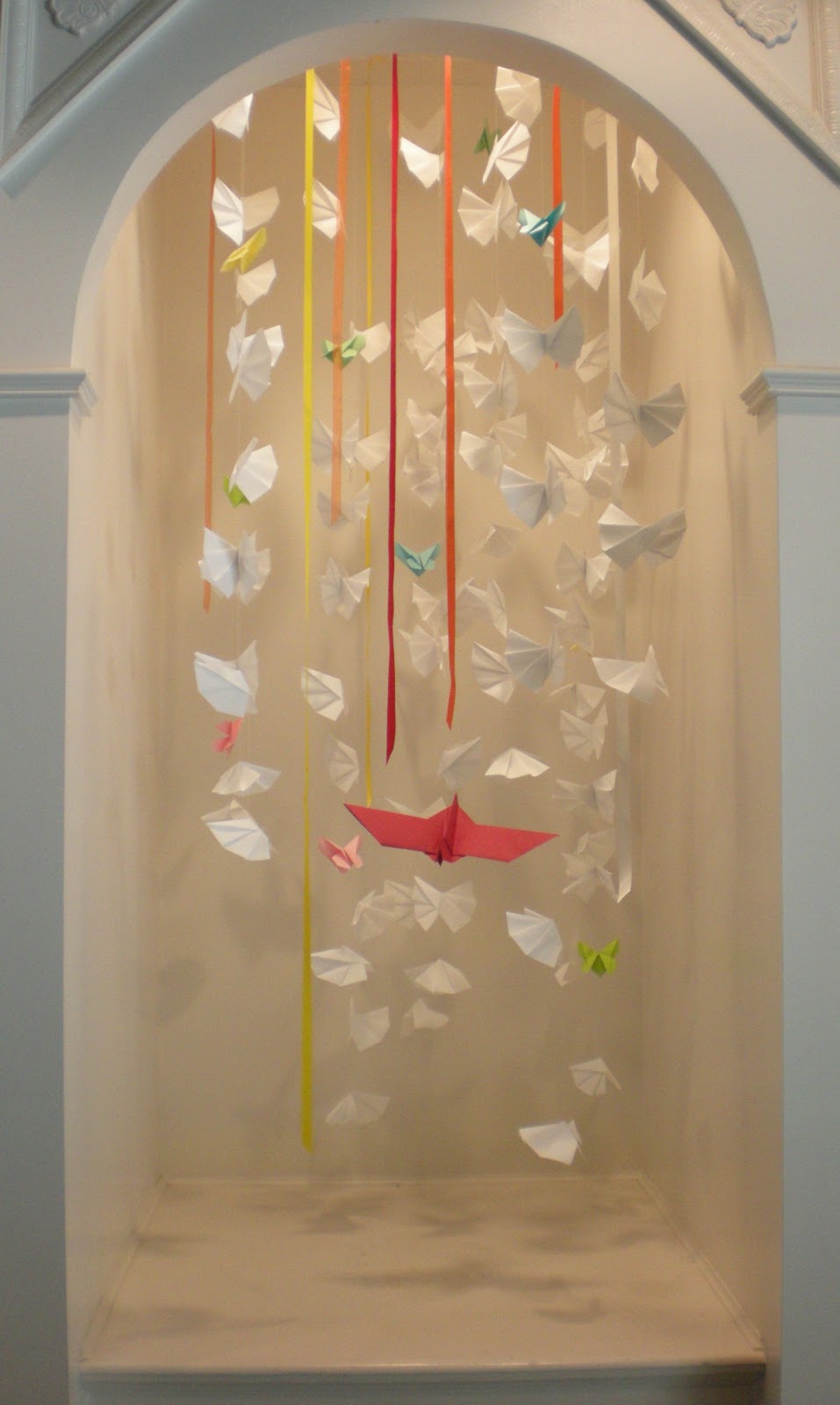
The Holy Spirit has often been depicted as a dove, based on the account of the Spirit descending like a dove on Jesus at his baptism. L'Art has added a dove and ribbons to the installations in the niches. The colors evoke the flame, and the manner in which the dove and butterfly figures are suspended allows them to move freely, bringing to mind the manner in which we are all moved by the Spirit.