Monday, January 18, 2010

The Woven Community


The Saga of the Woven Paraments Part 4:

Our goal became to create, through artful integration, a finished piece where dissimilar materials not only co-exist, but actually enhance each other. The blocks of solid provide a resting place for the eye; the prints add interest; the airy, open areas elevate the tenor. The dense supplies grounding for the sheer; the delicate softens the heavy. The light-colored fabric sets off the dark, so that each looks better than it did when standing alone. We began weaving from the bottom, working upward, and the design functions in the same way; the eye tends to look at the bottom of the piece first and is led upward. The lower area has more horizontal lines and is woven more tightly, giving a grounded effect. As the eye is drawn upward, some spaces open up, and some of the lines become more vertical. Also, the predominant colors become lighter as the design moves upward. By the time the viewer’s eye reaches the top, the materials have become slender and vertical, spiraling aloft. The suggestion is that of a tree, growing upward. The symbolism is that of ordinary time, when our growth should be spiritual, towards God.


Our congregation responded generously to our appeal for materials. We received fabrics and fibers with historical or sentimental value, items that have imbued our banners with meaning. We attempted to mingle all of these varied colors and fabrics, finding meaning and beauty together. We received such a wonderful outpouring - from sweaty t-shirts to wedding finery, from Boy Scout kerchiefs to Christmas Pageant costumes, from formal neckties to a dish towel of everyday family life, from the woolen plaid of a family tartan to the soft cotton of a baby’s onesie. Our hope is that these banners are a tangible depiction of the way our congregation is tightly woven together in community. Accordingly, we have entitled them “The Woven Community”. We decided that sounds more sophisticated than “Strata, Blobs, and Zig-Zags”!


Close-up of the Pulpit Cloth

The pulpit cloth was designed and woven by Molly.
The arrangement of lights and darks makes it appear as if a shaft of sunlight is coming in from above.


Close up view of the left banner.


Close up view of the right banner.

Strata, Blobs, and Zig-Zags


Sheryl exhibiting great patience.


Nancy and Molly going to great heights for their art.

Saga of the Woven Paraments Part 3: We began by weaving at the bottom of the loom with a simple under and over pattern, straight across. We quickly realized that this would produce a rather boring composition. After researching more advanced techniques, we experimented with inserting some rhomboid-shaped “lozenges” (as they are called in the weaving biz) to add contrast and interest. These inserts were intended to be tapered, diamond shapes, but we quickly discovered that with the thickness of our weft, the diamonds kept stubbornly winding up as, well, blobs. As we continued working, we learned to accept, and even to love, our blobs.


Next, we discovered that as we worked the weft in around these blobs, they acted as obstacles, forcing us to weave up and over and around them. One observer commented that it seemed to be a metaphor for life – just when you feel as if you’re sailing smoothly along, you encounter a problem that you have to work around. Romans 5 resonated with us: “ … we rejoice in our sufferings, knowing that suffering produces endurance, and endurance produces character, and character produces hope, and hope does not disappoint us, because God's love has been poured into our hearts through the Holy Spirit that has been given to us.” Having to work around the obstacles in our weaving produced interesting, wavy horizontal lines, which gave character to the piece. And that produced hope that our banners might turn out all right, after all. And we began to feel the Spirit that had been at work through us.


More confident now, we thought further about the purpose of the banners and our design. These paraments are intended for Ordinary Time, the period on the liturgical calendar that falls between our church holidays and celebratory seasons. It is a time for spiritual renewal, growth, and the building up of the church; traditionally, the dominant color is green.


Aren't Y'all Done Yet?


The weaving begins in August ..... and continues .... day by day .....


August leads into Sep
tember .... and we weave ...


And September turns into October .... and still we weave ....


October passes ..... and we're still weaving ...


And weaving .... and weaving ....


Novem
ber arrives ... to find us weaving.


The Saga of the Woven Paraments Part 2: We stepped out in faith, attempting to trust in God despite our continued self-doubts.

We put out the call for the congregation to contribute the materials. The congregation responded. We designed and built our own looms. We plunged into the weaving, learning as we went along. It went slowly. Very slowly. A common refrain heard in our vicinity for several weeks was a well-deserved, friendly mocking “Aren’t y’all done yet?”


We continued with our “on the job training”. The initial weaving concepts that we encountered were “warp” and “weft”. The warp threads are the strings that run vertically, from the bottom to the very top of the piece. The weft is the “fill” fabric that is woven horizontally under and over the warp threads. The weft is how the weaver introduces color and design, hopefully using creativity to make the piece unique.


Filled With the Skill?

Peter, builder of the looms, prepares to deliver them to the church for L'Art to begin their weaving project.

The Saga of the Woven Paraments Part 1: When L’Art decided to fashion new banners using the craft of weaving, we were truly stepping out in faith. Weaving was a technique that we found interesting, but one in which we had very little experience. Trusting that the spirit would guide us, we commenced our project without much of a plan.


We had virtually no budget.

We did not have a loom.

We had no fabric with which to weave.

None of us considered ourselves adept at weaving.

We didn’t have a clear idea of what the resulting piece would look like.


What did we have?

We had a supportive congregation and inspiration from Exodus 35, verses 23 – 29:


“And everyone who possessed blue or purple or crimson yarn or fine linen or goats' hair or tanned rams' skins or fine leather, brought them ... all the women whose hearts moved them to use their skill spun the goats' hair ... All the Israelite men and women whose hearts made them willing to bring anything for the work that the Lord had commanded by Moses to be done, brought it as a freewill offering to the Lord.”


Kathy works with the warp thread.


We felt that our hearts had moved us to create a work of art that would be a freewill offering to the Lord. However, reading ahead to verse 35:


“He has filled them with skill to do every kind of work done by an artisan or by a designer or by an embroiderer in blue, purple, and crimson yarns, and in fine linen, or by a weaver—by any sort of artisan or skilled designer.”


Molly and Nancy warp the looms.


Starting out, we privately thought to ourselves, and quietly spoke amongst ourselves:


“What do we think we’re doing?! We’re not artisan weavers! We haven’t been filled with the skill!”


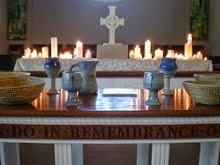
What is a Reredos?


Reredos is a term derived from a Middle Ages term; it's also known as a ReTable. At APC, it's the table behind the Table, where we can place a cross and candles when the Table is filled with trays and cups and the elements on Communion Sundays.


For special services and services held in the evening, it's especially effective to use a longer table and load it up with lots of glowing candles.

Sunday, January 17, 2010

Communing With the World


For World Communion Sunday, L'Art arranged a display of a variety of breads from different cultures and locations around the world.


Michael preparing the Table.

Bookmark it


The front view.


To "advertise" our team, L'Art created bookmarks to pass out to the New Members/Inquirers class.


The back view.