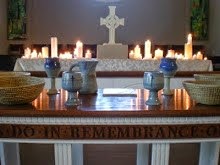
Pictured here is our sanctuary on the third week of Advent. On the rod to the right of the chancel are the banners from Week 1 (far right) and Week 2 (middle). The empty space is waiting for the banners from Week 3 and Week 4 to be added. The negative space is meant to symbolize our anticipation of the future. Week 3's banner is hanging in the chancel. It has more streaks of light and gold, symbolizing the in-breaking of God's kingdom as we grow nearer to the time of the birth of our Savior.
Thursday, December 3, 2009
From Darkness to Light
Pictured here is our sanctuary on the third week of Advent. On the rod to the right of the chancel are the banners from Week 1 (far right) and Week 2 (middle). The empty space is waiting for the banners from Week 3 and Week 4 to be added. The negative space is meant to symbolize our anticipation of the future. Week 3's banner is hanging in the chancel. It has more streaks of light and gold, symbolizing the in-breaking of God's kingdom as we grow nearer to the time of the birth of our Savior.

Seeking Wholeness: Advent 2007

The following Artist Statement was included in our church bulletin:
The shopping malls and television stations want you to think that Christmas is already here. Within the walls of our sanctuary, however, we follow a different calendar: the church’s liturgical calendar. The four weeks preceding Christmas day are known as Advent.
Advent is a season of hope and of anticipation. We look to the time when God’s kingdom completes breaking into our world. However, it is not a time of pure hope and joy. We must acknowledge that redemption is necessary because we are broken people. This is a time to remember why we need the Savior and why we long for a world made complete. We practice waiting in Advent, as we move from darkness to light, from brokenness to fullness, from tension to peace.
The Liturgical Arts Committee has created a new set of banners and paraments in hopes of helping our congregation to reflect upon Advent themes. You will notice that the banners evolve over the course of the month, symbolizing our progression towards the event of Christ’s birth. The banners make use of the traditional colors for Advent, purple and blue. As the season progresses towards Christmas, gold and white become more prominent, showing our spiritual growth from dark to light and from brokenness to fullness. You may also note that the fabric has been left with rough edges – this is meant to symbolize the imperfect world that we are living in. The stoles and pulpit cloth were pieced together from random scraps of fabric; we don’t have to be perfect or whole to be used by God.
 This is our Associate Pastor, Stephanie M., wearing one of the stoles quilted by Kathy D.
Wednesday, December 2, 2009
The Anticipation of Advent


By November of 2007, two additional members had joined the team (Kathy D. and Brooke S.) The group decided to create a set of evolving banners and paraments for the Advent season. Because of our short time frame and our need for a new set each week, it was decided to use a more “temporary” construction style, rather than choosing a method that involved extensive sewing and finish work. One idea considered was to hang strips of rough cut fabric, adding and subtracting various fabrics and colors as the season progressed. When the team realized that this idea dovetailed with the theological theme of Advent (moving from darkness to light, anticipating wholeness) this was the method selected. Kathy, using her quilting skills, created three stoles and a pulpit cloth to coordinate with the banners.
Prayers of the People

By the spring of 2007, Molly and Nancy had recruited more members and formed the Liturgical Arts Team. Nancy and Molly were joined by Sheryl W. and LaRhonda W., with Peter L. providing technical assistance. For their first “group” project, they designed an installation called “The Prayers of the People” which was installed for Easter morning, 4/8/2007, and was left up for several weeks.
The team began the project by soliciting prayers from all members of the congregation. The prayers were written on slips of pre-cut pieces of paper. Hundred of prayers were collected - prayers of thanks, confession, intercession ... prayers from children ... prayers about life or death matters ... prayers about personal issues and prayers for our church, community, and world. The prayer slips were sewn to long, white strips of fabric, forming prayer banners. These banners were draped like streamers from the ceiling in the narthex, forming a canopy effect. These pictures show the "Presbyterian sweatshop", as we sew the hundreds of prayer slips to the dozens of banners. Also shown is the installation process, and the finished piece.
The team received a lot of positive feedback from this installation, emboldening them to continue their efforts of bringing an art ministry to APC.


Not Just "The Banner Committee"
Now that Molly and Nancy had completed banners appropriate for an entire Liturgical year, they felt called to branch out a bit. Fortuitously (or was is the working of the Spirit?), a workshop was being offered at the Lay Institute at their local Presbyterian Seminary (Columbia Theological Seminary in Decatur, GA). The program was intended for lay leaders or church professionals, focusing on how to create and use visual art in worship services and sacred spaces. The keynote presenter was Catherine Kapikian and it is her art on the cover of the brochure that is pictured here. The event lasted 4 days and included lectures, hands-on workshops, daily worship, and small group discussions. Molly and Nancy were inspired and excited by all that they observed and learned! They began planning how they could recruit more members to their team and begin to bring more visual art to their church. 

Tuesday, December 1, 2009
The Birth of the Church

For Pentecost, our church had been using a pulpit cloth which incorporates the dove and flame imagery that are traditional symbols for the Holy Spirit. Inspired by this design, in 2006, Molly E. created coordinating banners and a cloth for the Table. These paraments are used annually for Pentecost, as well as for Ordination and Installation services.
Lent
 For Lent, our church uses banners and a pulpit cloth of plain brown burlap with a solid purple border, representing the season’s mood of penitence and simplicity.
Subscribe to:
Posts (Atom)